In Germany and the European Union, digital sovereignty means the emancipated and autonomous use of digital resources — avoiding one-sided dependencies and the disadvantages that come with them. This stands in contrast to how the term is sometimes used elsewhere, where it can refer to state control over internet access.
"This article focuses exclusively on digital sovereignty understood as the independent and self-determined use of digital functions and services — a fundamental prerequisite for the sustainable protection of human rights, democracy, and economic prosperity."
Dimensions of a Digital Sovereignty Radar
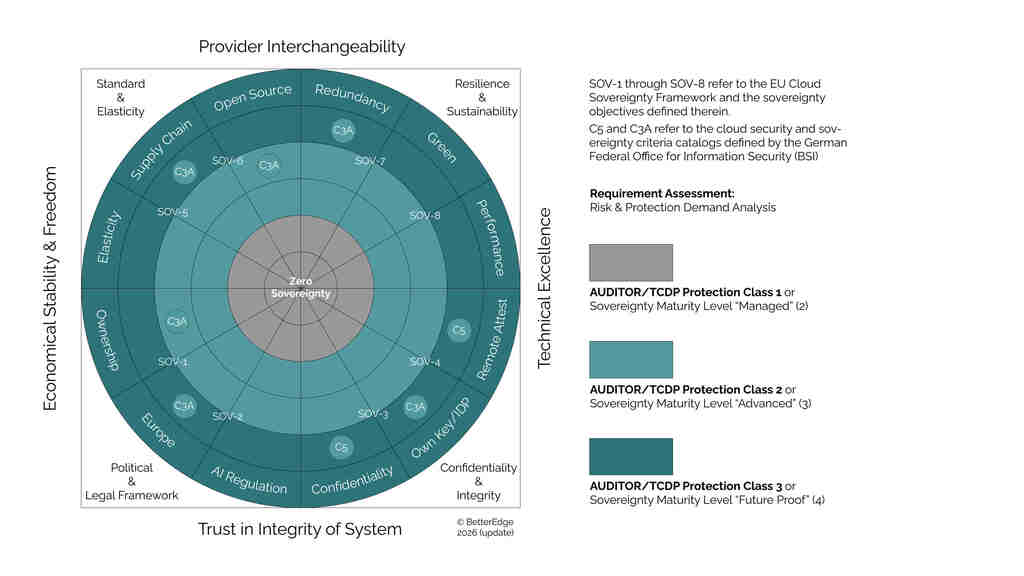
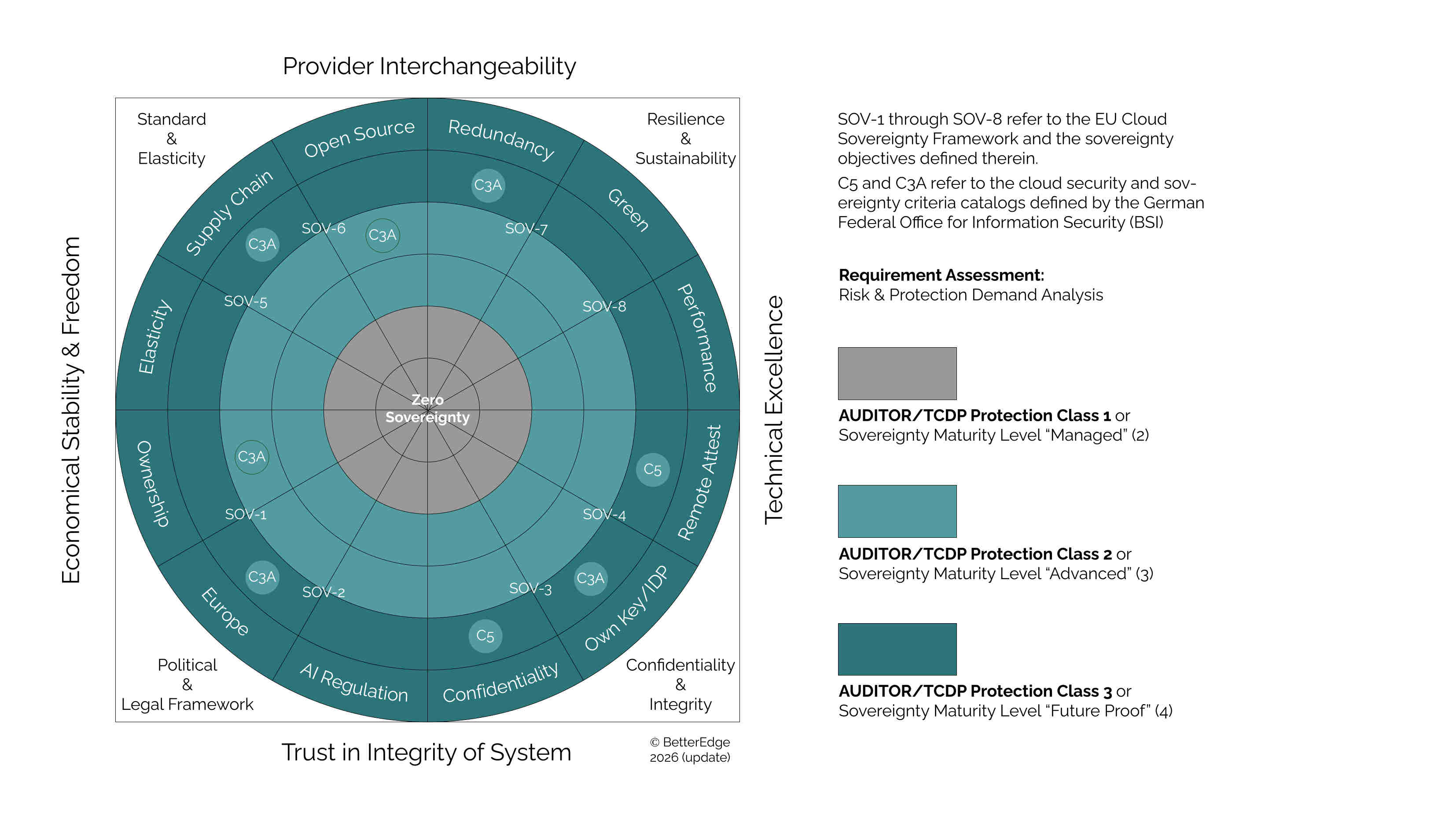
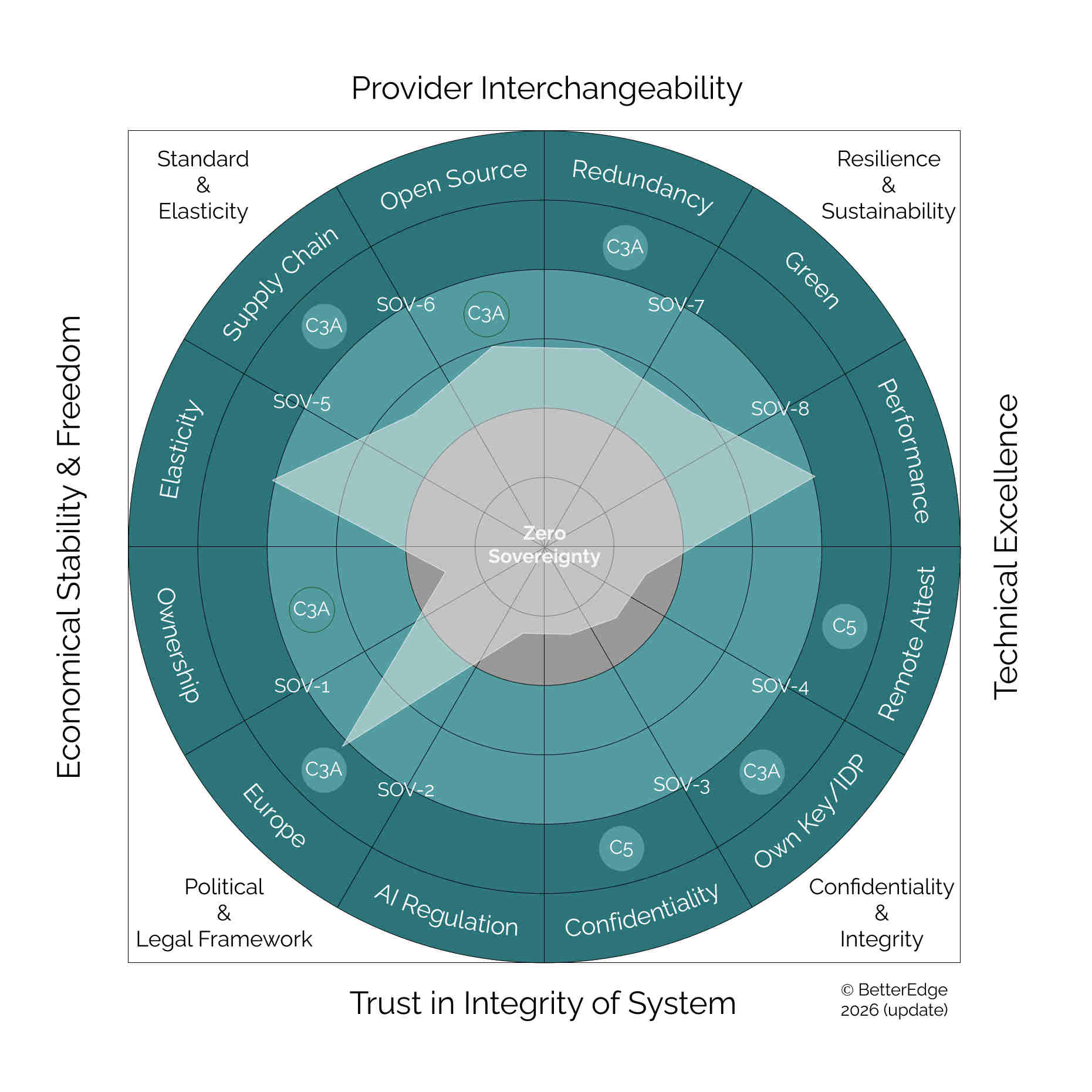
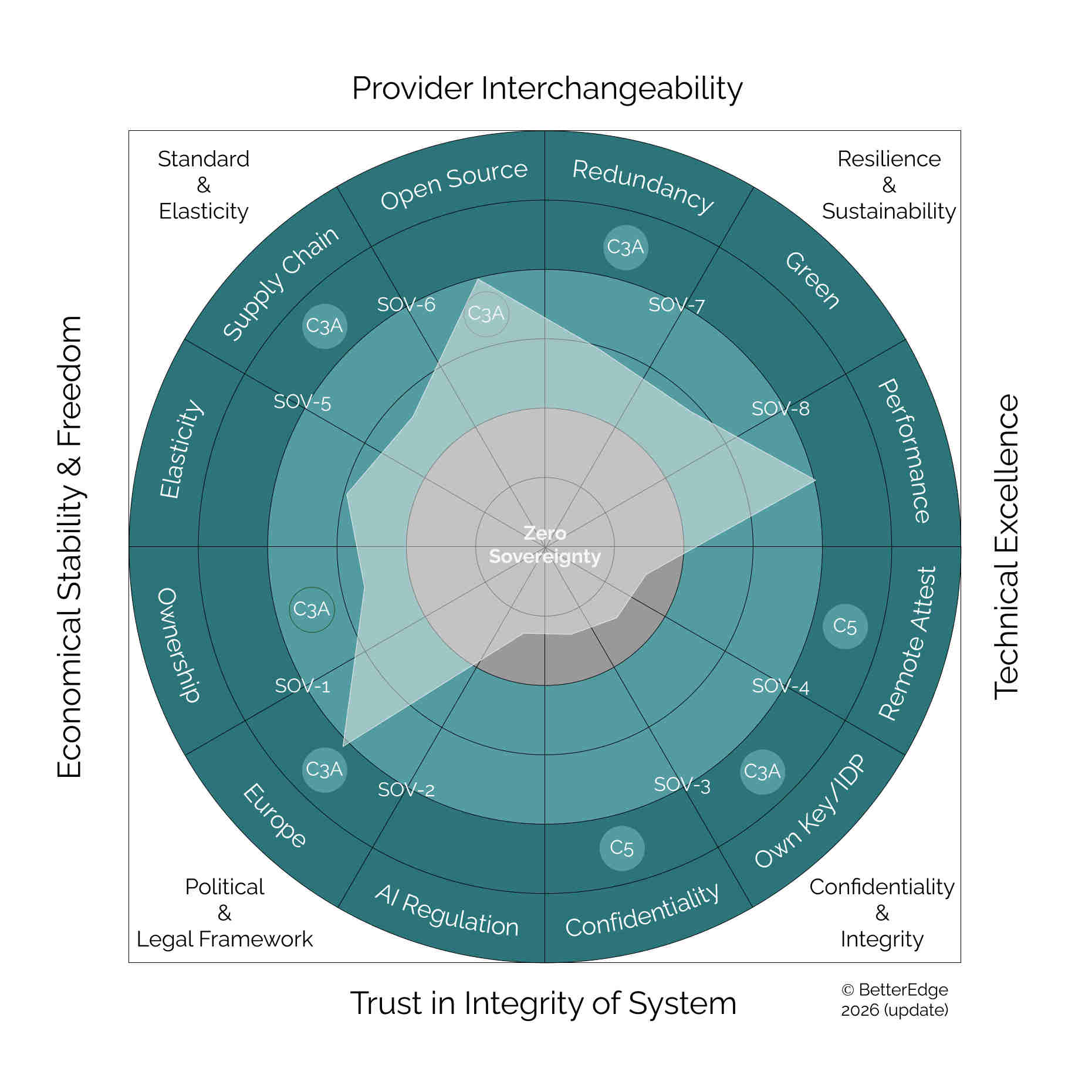
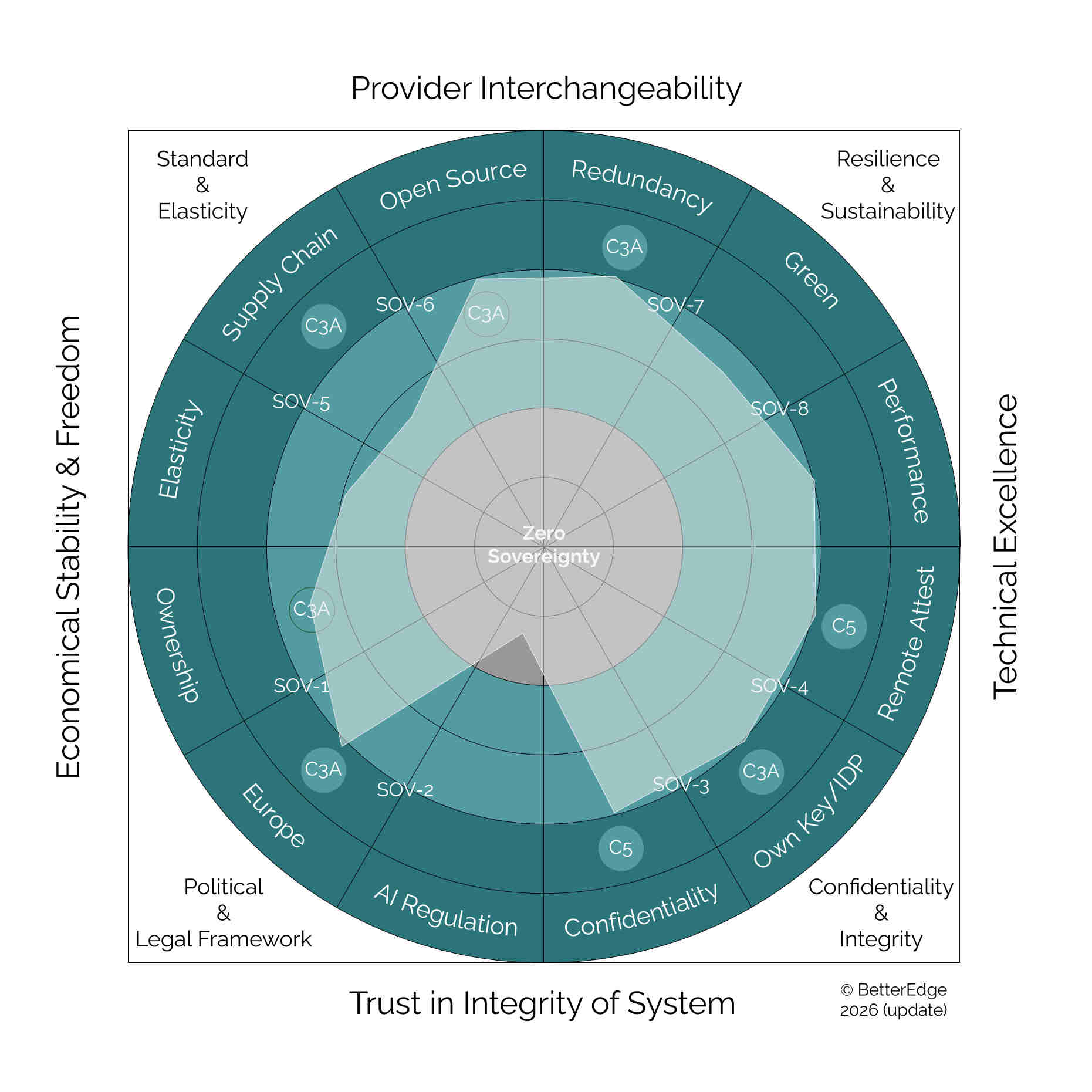
Sovereignty is often simplistically equated with operating IT infrastructure domestically or relying on open-source software. However, the freedom to assume digital roles in a self-determined and secure manner encompasses a far broader set of factors, all of which should be reflected in the proposed Digital Sovereignty Radar. The Radar’s essential division is between an upper half focused on provider interchangeability and a lower half concerned with trust in the computing infrastructure.
Provider Interchangeability
Covering open source, redundancy, supply chain, elasticity, and standards—ensuring no single vendor can create a lock-in situation.
Trust in Integrity of System
Covering confidentiality, own key/IDP, remote attestation, AI regulation, Europe, and ownership—ensuring systems remain under full legal and technical control.
click to enlarge
.
Digital Sovereignty Radar
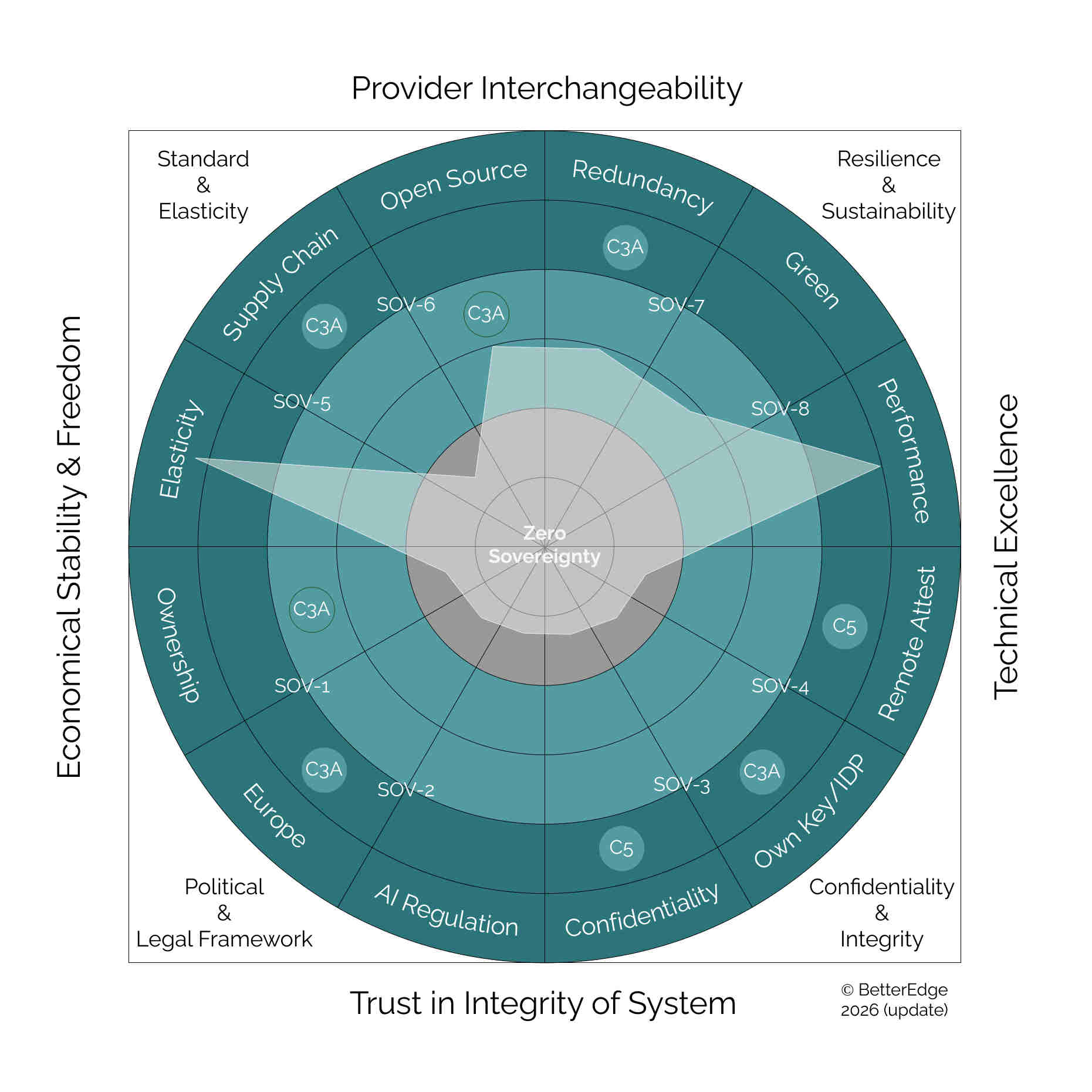
See how different IT systems score across the twelve dimensions of digital sovereignty.
1 / 4
Example 1
Non-EU Hyperscaler
The offerings of non-EU hyperscalers excel in performance and elasticity and, as long as no change of operator is required, provide highly favorable conditions for the development of business activities.
Excel in performance and elasticity
Data portability via open standards
Transparency and verifiability insufficient
Unfavorable legal jurisdiction cannot be compensated through ownership
Example 2
EU-Hyperscaler
European hyperscalers capitalize on the fact that both their ownership structures and their infrastructure are located within the European legal jurisdiction.
Ownership and infrastructure within EU legal jurisdiction
Transparency superior to traditional hyperscalers
Performance and elasticity only marginally weaker
Unclear compliance when using non-EU application software
Example 3
Current's Classic Best-of-Open-Source
Imagine a deployment of OpenCloud or Nextcloud hosted by one of the major German providers such as IONOS or Hetzner. The advantages of open-source software and of operating within German data centers are fully realized.
Full open-source software stack
Hosted in German data centers
Standardized data formats and portability
All advantages of EU legal jurisdiction realized
Example 4
Today's Feasibility
Open-source software is operated in European data processing facilities by a provider whose ownership structure is fully rooted in Europe. Best-practice confidential computing as well as data and system backup mechanisms are implemented.
Open-source software in European facilities
Provider ownership fully rooted in Europe
Best-practice Confidential Computing implemented
Sovereignty anchor ensures full key ownership and autonomy
The Radar as a Foundation for Work on Digital Sovereignty
The Digital Sovereignty Radar introduced in this article is more than an illustration—it is a starting point for honest, structured, and actionable conversations about digital independence. Each of the twelve dimensions can be assessed, measured, and improved over time. As organizations grow more aware of the risks tied to vendor lock-in, unfavorable legal jurisdictions, and insufficient runtime protection, the radar provides a shared language to navigate these challenges. The ongoing development of sovereignty indices by leading organizations signals a broader shift in the industry—one where digital sovereignty moves from an abstract ideal to a measurable, comparable, and achievable standard.We look forward to contributing to this evolution and to seeing the radar serve as a practical compass for organizations on their path toward full digital sovereignty.